
Tabel Of Contents
- How Does High Altitude Affect Your Menstrual Cycle?
- Does Your Period Affect Altitude Sickness?
- When to Seek Medical Advice?
- How to Tackle Periods During Trekking at High Altitude?
- What to Pack for Period Management on a High-Altitude Trek?
- Should You Cancel Your Trek Because of Your Period?
- How Women Adventures Supports Women on the Trail
- FAQs About Altitude and Your Period
Yes, high altitude can affect your period.
Changes in air pressure, reduced oxygen levels, and the physical stress of trekking can cause your menstrual cycle to become irregular, heavier, lighter, or even temporarily stop. For most women, the change is a normal physiological response to altitude; not usually a cause for alarm and not a reason to cancel your trek.
It is also one of the most under-discussed topics in trekking. Historically, men have written the vast majority of trail guides, packing lists, and altitude advice. That gap leaves a lot of women heading into the Himalayas with unanswered questions and unnecessary anxiety.
This guide fills that gap. We cover the science of how altitude affects your menstrual cycle, the practical changes you can expect on the trail, how to manage your period at high altitude with confidence, and exactly what to pack, including guidance on when to seek medical advice.
How Does High Altitude Affect Your Menstrual Cycle?
What Happens to Your Body at High Altitude?
When you ascend to high altitudes, barometric pressure drops, and the air contains less oxygen. Your body responds by triggering a stress response, increasing heart rate, altering breathing patterns, and redirecting resources toward survival functions. This physiological shift is called hypoxia (reduced oxygen availability to body tissues), and it affects far more than just your lungs. As you gain altitude, oxygen saturation, the percentage of Haemoglobin in your blood carrying oxygen, drops measurably, often falling from a sea-level norm of 95%–99% to below 90% above 3,500 meters.
One of the less obvious effects involves your reproductive hormones. The hypothalamic-pituitary-adrenal (HPA) axis, the system that governs your body's stress response can suppress the hormones that regulate your menstrual cycle when it perceives sustained physical or environmental stress. In simple terms, your body prioritizes survival functions over reproductive ones.
This is not hypothetical. According to a study published in the International Journal of Gynaecology and Obstetrics (Escudero et al., 1996), hormone profiles during the menstrual cycle differ measurably between women living at sea level and those living at high altitude, with differences in oestrogen and progesterone concentrations at multiple cycle stages. Medical literature has well established the physiological basis for menstrual disruption at altitude.
Acclimatization, the process by which your body gradually adjusts to lower oxygen levels, typically takes between two and five days for each significant elevation gain. During this window, your hormonal environment is the least stable, and menstrual cycle irregularity is most likely to occur. See our guide to acclimatization at high altitudes for a detailed look at how to plan your ascent safely.
Common Changes Women Experience at Altitude
Women who trek or live at high altitude report a wide range of menstrual cycle changes. The most commonly documented include the following:
- Period delay or missed period are among the most common concerns; your menstrual cycle may arrive several days late or, during extended expeditions, may not occur at all.
- Changes in flow: bleeding may become heavier or lighter than your normal.
- Spotting: light bleeding between periods is a well-documented response to physiological stress at altitude.
- Intensified or reduced cramping: dysmenorrhoea (painful menstruation) can worsen or, interestingly, improve.
- Temporary amenorrhoea: menstruation may pause entirely, particularly on extended high-altitude expeditions.
As the International Climbing and Mountaineering Federation (UIAA) Medical Commission confirms in its guidance for women going to altitude, menses can be blocked, longer, shorter, or irregular at altitude.
It is important to acknowledge that altitude is rarely the only variable. Jet lag from long-haul travel, the physical demands of daily trekking, cold temperatures, weight change, disrupted sleep, and the emotional intensity of a major adventure all contribute to hormonal fluctuation.
Does High Altitude Make Your Period Heavier?
This is one of the most common questions women ask before a trek, and the honest answer is that high altitude can affect menstrual flow, but the extent of this effect varies among individuals.
A 2025 study of 136 Andean women living above 3,500 meters found that both painful periods and heavy bleeding were more common at higher altitudes (medRxiv, 2025; preprint, not yet peer reviewed; findings should be considered preliminary). This is the most specific data currently available on this question, and it suggests a real, though individual, association.
However, many women report no change in flow at all, and others experience their periods lighter during the physical exertion of a trek. There is no universal rule. If you do experience heavier bleeding at altitude, it is a known and documented phenomenon, almost always temporary, and it does not mean something is wrong with you.
Does Your Period Affect Altitude Sickness?
This is the question most guides never think to ask, and it matters.
Many women wonder whether trekking at a particular phase of their menstrual cycle puts them at greater risk of acute mountain sickness (AMS), a condition causing headaches, nausea, dizziness, and fatigue at high altitudes. The concern is understandable: if your body is already under hormonal stress, does that compound the risk?
The evidence says no. A 2024 study published in High Altitude Medicine & Biology (Gardner et al.) examined 1,161 female trekkers assessed at Lobuche (4,940m) and Manang (3,519m) in Nepal, one of the largest studies of its kind, and found no statistically significant relationship between menstrual cycle phase and the incidence or severity of acute mountain sickness. The researchers also found that hormonal contraception at altitude had no meaningful effect on AMS risk.
This is worth stating clearly for women who use hormonal contraception and worry it might interact badly with altitude. The evidence does not support that concern. Your contraceptive method does not increase your susceptibility to altitude sickness. If you have specific questions about your method and altitude, your GP is the right person to ask, but the research gives no cause for alarm.
The risk factors for AMS are ascent speed, hydration, fitness, and individual physiology – are the same for every trekker, regardless of menstrual cycle phase or contraceptive use.
Period Symptoms vs. Altitude Sickness Symptoms: How to Tell the Difference
There is one practical complication worth flagging: some symptoms of altitude sickness overlap with menstrual discomfort. Both can involve headache, nausea, fatigue, and a general sense of feeling unwell. On the trail, this overlap can cause confusion.
A useful rule of thumb:
- Period-related symptoms tend to be localized lower abdominal cramping, pelvic heaviness, breast tenderness (or mastalgia), and mood shifts. They are familiar to you from your normal cycle.
- AMS symptoms tend to be systemic, a persistent headache that worsens with ascent, nausea or vomiting, dizziness, difficulty sleeping, and a noticeable reduction in energy or coordination. Critically, AMS symptoms typically worsen the higher you go and improve when you descend.
If you are unsure whether what you are experiencing is menstrual discomfort or altitude sickness, treat it as altitude sickness until proven otherwise. Descend if symptoms worsen. Your guide can help you assess your goals.
For most women, the data strongly supports trekking during your period without concern. However, every woman's body is unique. If you experience any symptoms while on the trail, it's always best to consult your guide or a medical professional.
When to Seek Medical Advice?
Most menstrual changes at altitude are temporary and resolve on their own once you descend. However, there are situations where you should seek medical attention promptly from your guide, a health post on the trail, or a doctor after descent.
Seek medical advice if you experience any of the following:
- Unusually heavy bleeding: soaking more than one pad or tampon per hour for two or more consecutive hours warrants evaluation.
- Severe or unfamiliar pelvic pain: cramping dramatically worse than your normal experience, especially if it does not respond to ibuprofen.
- Dizziness, fainting, or near-fainting: may indicate changes in blood pressure or significant blood loss and require immediate assessment.
- Symptoms that persist after descent: any menstrual irregularity continuing more than one or two cycles after returning to your normal altitude.
- Any possibility of pregnancy: unexpected heavy bleeding or missed periods at altitude in someone who could be pregnant requires urgent evaluation.
- Known gynaecologic conditions: If you have a history of endometriosis, fibroids, or PCOS, discuss altitude trekking with your gynaecologist before departure.
- Symptoms you cannot distinguish from AMS: if headache, nausea, or extreme fatigue do not fit your normal period pattern, assume altitude sickness until assessed.
If in doubt, descend. No trek itinerary is worth ignoring symptoms that could indicate a serious condition.
How to Tackle Periods During Trekking at High Altitude?
Managing your period on the trail is entirely doable with the right preparation. The women who struggle are almost always those who underestimated supplies or over-complicated logistics. Here is what actually works.
Menstrual Products for Trekking: What Works Best
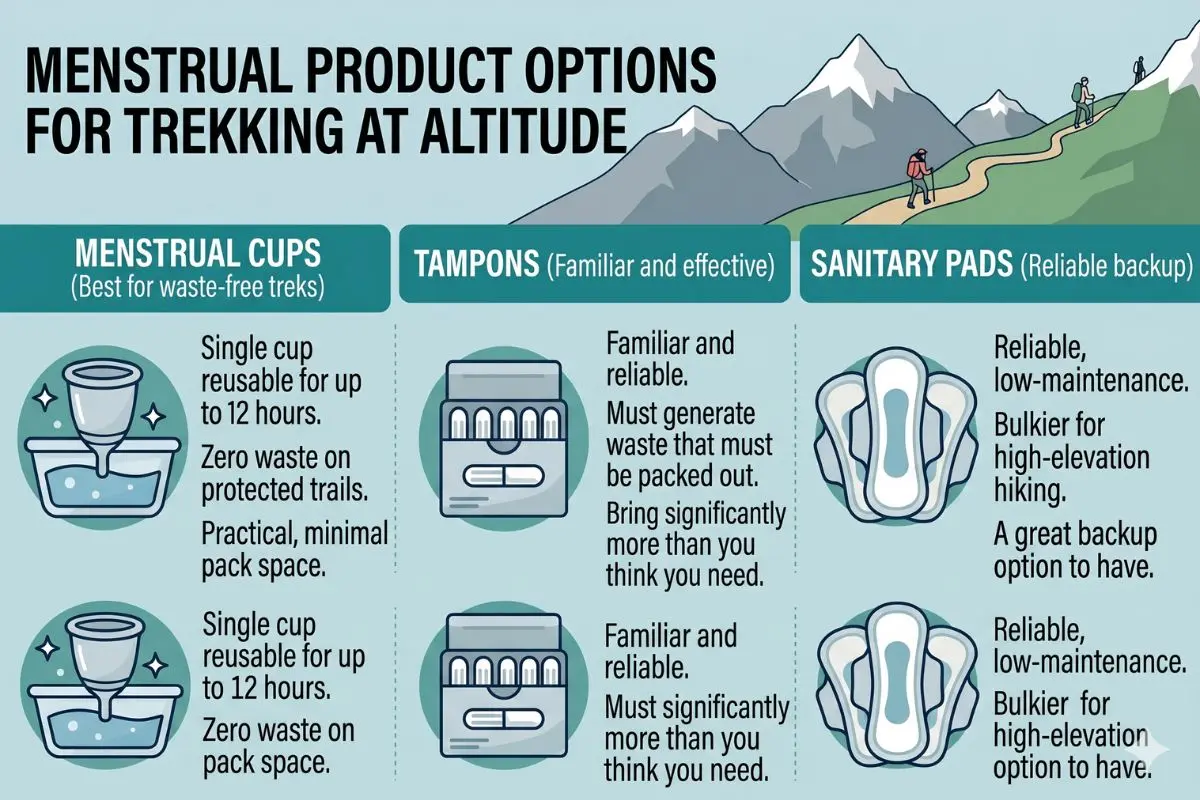
- Menstrual cups are widely regarded as the most practical option for high-altitude trekking. A single cup can be worn for up to 12 hours, produces zero waste on protected trails, is reusable across the full trek, and takes up almost no pack space. Practice at home for at least one or two cycles before your trek.
- Tampons are familiar and effective but generate waste that must be packed out in Nepal's protected trekking areas. Bring significantly more than you think you need.
- Pads are reliable and low-maintenance but bulkier during active days of high-elevation hiking. A practical backup option.
- Period underwear works well as a backup layer but should not be your primary product given limited laundry access on the trail.
Important: Bring more than your calculation suggests. Altitude may cause your period to arrive early or last longer than usual. Being caught short at a teahouse at 4,500 metres is avoidable with an extra day's worth of supplies.
Hygiene on the Trail When Facilities Are Basic
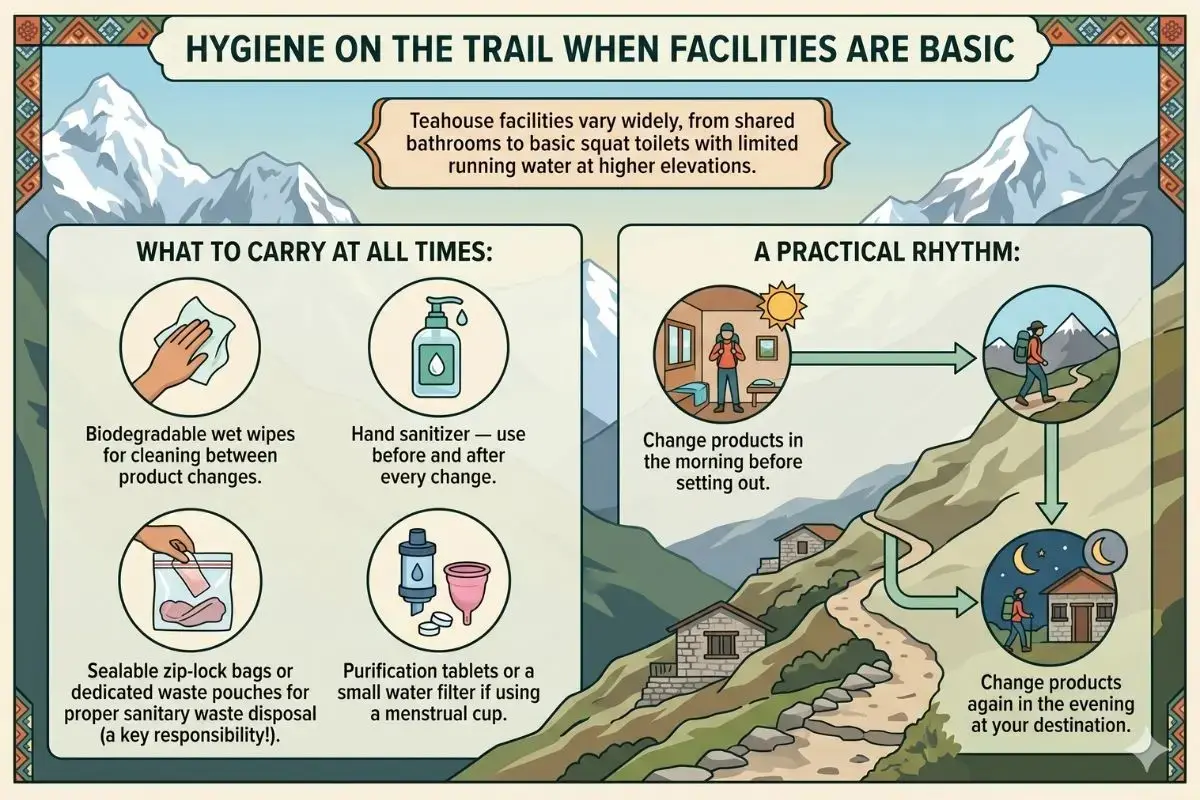
Teahouse facilities on Nepal's trekking routes vary enormously from clean shared bathrooms at popular stops to basic squat toilets with limited running water at higher elevations.
What to carry at all times:
- Biodegradable wet wipes for cleaning between product changes.
- Hand sanitizer; use before and after every change.
- Sealable zip-lock bags or dedicated waste pouches or proper sanitary waste disposal is a trekking responsibility on all Himalayan trails.
- Bring purification tablets or a small water filter if you plan to use a menstrual cup.
A practical rhythm that works well: change products in the morning before setting out and again in the evening at your teahouse destination.
Dealing with Cramps and Discomfort at Altitude
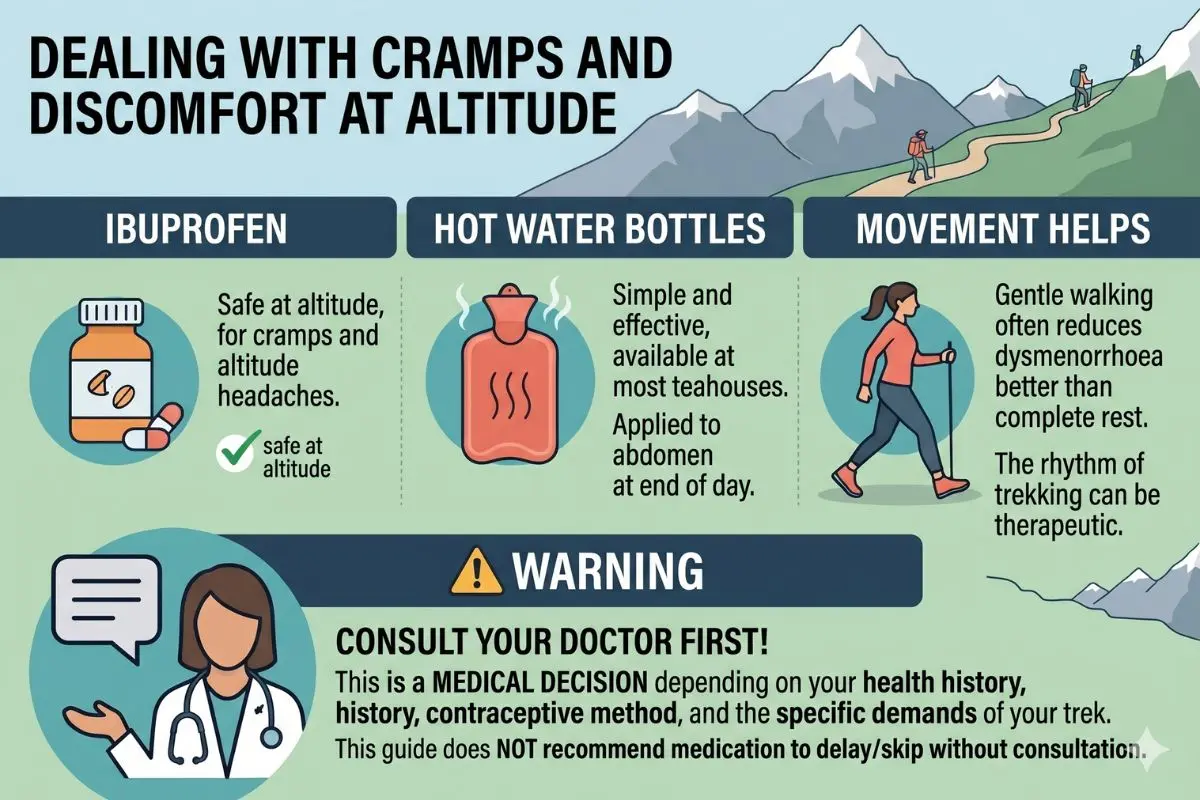
- Ibuprofen is safe to take at altitude and addresses both menstrual cramps and altitude-related headaches. Carry it regardless of your cycle timing.
- Hot water bottles are available at most teahouses. Applied to the abdomen at the end of a trekking day, they are simple and effective.
- Movement genuinely helps. Gentle to moderate walking often reduces dysmenorrhea better than complete rest. The rhythm of trekking can be therapeutic.
This guide does not recommend taking medication to delay or skip your period without first consulting your doctor. This is a medical decision that depends on your individual health history, contraceptive method, and the specific demands of your trek.
What to Pack for Period Management on a High-Altitude Trek?
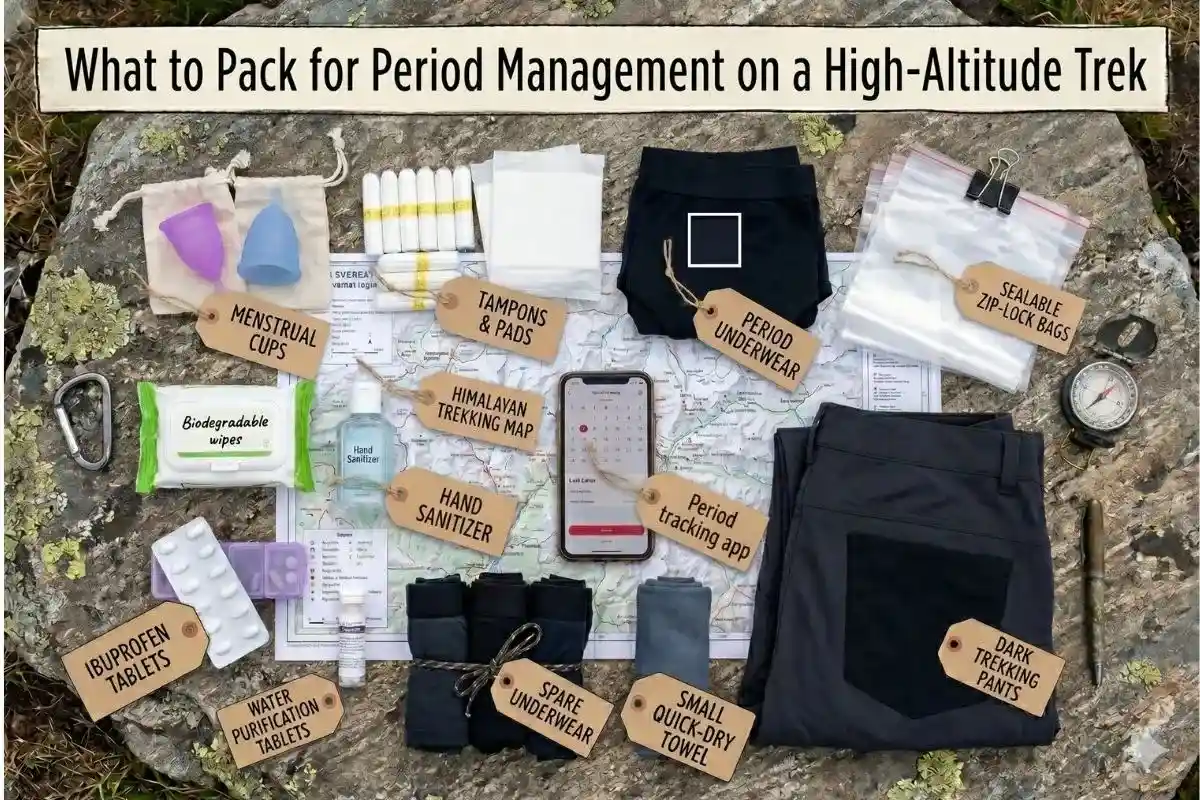
Plan for your full trek duration plus three to four additional days. For a complete gear checklist beyond period supplies, see our full packing list for women trekkers.
| Item | Notes |
| Menstrual cup (×2) | Two cups as backup; practice before the trek |
| Tampons or pads | Full trek supply + 4 extra days; more than you think |
| Period underwear (×2 pairs) | Backup layers; dark colours preferred |
| Sealable zip-lock bags | Sanitary waste disposal; bring at least 10 |
| Biodegradable wipes | For product changes away from water |
| Hand sanitiser (small bottle) | Before and after every change |
| Ibuprofen | Cramps + altitude headaches; 200–400mg tablets |
| Water purification tablets | Essential if using a menstrual cup |
| Spare underwear (×3 extra pairs) | Dark trekking colours |
| Dark-coloured trekking pants | Practical insurance on heavier days |
| Small quick-dry towel | Personal hygiene; separate from main towel |
| Period tracking app | Log any changes; useful for post-trek medical review |
Should You Cancel Your Trek Because of Your Period?
No, and the research supports that clearly.
Thousands of women trek at high altitude during their periods every single year on the Everest Base Camp trail, the Annapurna Circuit, the Langtang Valley, and every other major Himalayan route. Your period does not make you less capable, less safe, or less prepared than any other trekker on the trail.
The research is clear: your menstrual cycle phase has no meaningful impact on your risk of altitude sickness. Nepal now requires all trekkers in designated areas to trek with a licensed guide; meaning you are never navigating a difficult day alone, whatever the reason.
If you have broader concerns about safety as a solo woman trekker in Nepal, read our complete guide to solo female trekking safety in Nepal as it covers permits, guides, accommodation, and what to expect on the trail.
Your period is not a weakness. It is your body doing exactly what it is designed to do, even at 5,000 meters.
How Women Adventures Supports Women on the Trail
At Women Adventures, we have built our trekking experience specifically around the needs of women. Our female guides and team have personal experience managing menstruation on high-altitude treks and can provide discreet, knowledgeable support on the trail. They know which teahouses offer better facilities, when to build in additional rest, and how to approach these conversations without making them a bigger deal than they need to be.
Women Adventures Pvt. Ltd. offers private trekking options for women who prefer more personal space on the trail, and our itineraries include built-in acclimatisation days, scheduled rest that serves both altitude adjustment and general physical comfort.
Ready to plan your trek with confidence? Talk to a Women Trek Expert and tell us your timeline, your concerns, and your goals. We will handle the rest.
FAQs About Altitude and Your Period
Can High Altitude Affect Your Period?
Yes. Reduced oxygen levels, physical stress, and air pressure changes can cause your menstrual cycle to become irregular, heavier, lighter, or temporarily stop. For most women, such a change is a normal physiological response, not usually a cause for alarm.
Does High Altitude Make Your Period Heavier?
It can, but it varies. A 2025 preliminary study of Andean women found that heavy menstrual bleeding prevalence may increase with altitude, though findings are preprints, and the effect varies significantly between individuals.
Can Altitude Cause Spotting?
Yes. Spotting between periods is a documented response to physiological stress at altitude and sustained exertion. It typically resolves once you descend or acclimatize.
Does Your Period Affect Altitude Sickness?
No. A 2024 study of 1,161 female trekkers in Nepal (Gardner et al.) found no relationship between menstrual cycle phase and acute mountain sickness risk or severity.
Can I Trek During My Period?
For most women, yes. With the right preparation and appropriate menstrual products, trekking during your period is safe and manageable. If you have an underlying gynaecologic condition, discuss it with your doctor before departure.
Should I Take Pills to Delay My Period Before a Trek?
Consult your doctor before making this decision. Do not self-medicate. Most travel health professionals advise managing your period on the trail rather than chemically postponing it, unless there are specific clinical reasons to do so.
What’s the Best Menstrual Product for High-Altitude Trekking?
Menstrual cups are widely considered the most practical option, as they are reusable, zero waste, up to 12 hours of wear, and minimal pack weight. Practice using one before your trek.
Does Flying Affect Your Period?
Short-haul flights have minimal impact. Long-haul international travel combined with significant time zone changes can cause minor, temporary cycle changes for some womem, particularly relevant if flying from the US, Europe, or Australia to Nepal.
How Should I Prepare for Trekking at High Altitudes?
Build cardiovascular fitness before departure. Pack altitude-appropriate layered clothing and menstrual supplies for unexpected cycle changes. Secure travel insurance that includes helicopter evacuation. Plan itineraries with acclimatization rest days and do not rush your ascent. See our complete Nepal trekking preparation guide for a full checklist.
Does Altitude Affect Hormones?
Yes. Research shows that oestradiol and progesterone levels differ in women at high altitude compared to sea level (Escudero et al., 1996). These hormonal shifts are the underlying mechanism behind menstrual cycle irregularity experienced during high-altitude treks.
When Should I See a Doctor About Menstrual Changes at Altitude?
Seek medical advice if you experience unusually heavy bleeding, severe or unfamiliar pain, dizziness or fainting, symptoms that persist after descent, or symptoms you cannot confidently distinguish from altitude sickness. If in doubt, descend and consult a medical professional.